Executive Summary
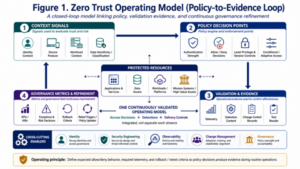
Zero trust is best understood not as a product set or perimeter refresh, but as an operating model for making, enforcing, and continuously validating trust decisions across identities, devices, workloads, applications, data, and infrastructure. For federal and defense organizations, the practical challenge is applying those principles in hybrid, legacy-constrained, and mission-critical environments without degrading operations or turning modernization into compliance theater. The strongest programs treat zero trust as an evidence-centered engineering discipline: define policy expectations explicitly, validate them continuously, and connect architecture, operations, and delivery pipelines into one measurable system.
In practice, mature programs begin with one high-value workflow, define explicit access and telemetry expectations, test those expectations before broad rollout, and scale only when they can show that policy, detection, and recovery behaviors hold under change. This phased, evidence-first approach reduces regression risk, limits blast radius, and makes continuous monitoring, auditability, and modernization outcomes more defensible.
- Testable policy outcomes: Define expected allow/deny behavior, authentication strength, posture requirements, required telemetry, and rollback criteria before expanding access.
- Phased modernization: Start with a crown-jewel workflow, use approved controls that meet the security outcome, and manage exceptions as time-bound risk decisions with owners and retest triggers.
- Evidence-first operations: Build decision logs, test results, signed artifacts, and telemetry traceability into routine delivery and operations so assurance depends on operational evidence, not manual reconstruction.
SCOPE AND ANALYTICAL FRAME
This white paper is written for federal cybersecurity architects, identity leaders, SOC managers, platform engineers, DevSecOps teams, and technical program managers responsible for modernizing enterprise security controls. It uses NIST SP 800-207 as the primary definition of zero trust architecture; NIST SP 1800-35 and CISA’s Zero Trust Maturity Model as maturity and governance lenses; NIST SP 800-218 as the secure software development baseline; and NIST SP 800-204D as a supply chain and CI/CD security reference (Chandramouli et al., 2024; CISA, 2023; Rose et al., 2020, 2025; Souppaya et al., 2022). The paper deliberately avoids tool-specific prescriptions except where public standards or common implementation patterns help clarify the architecture.
The threat environment assumed here extends well beyond an external adversary attacking a perimeter. Modern enterprise risk includes credential theft, weak phishing resistance, session hijacking, unmanaged devices, excessive standing privilege, cloud misconfiguration, insecure APIs, lateral movement, malicious or careless insiders, shadow SaaS adoption, and software supply chain compromise. STRIDE remains useful for design-time threat enumeration because it surfaces common failure modes early. MITRE ATT&CK is more useful for operational detection coverage because it provides a shared adversary-behavior vocabulary for credentialed access, persistence, privilege escalation, defense evasion, lateral movement, and exfiltration (Microsoft, 2022; MITRE, n.d.).
The modernization logic is architectural and economic: prioritize zero trust controls around workflows and resources whose compromise would create disproportionate mission, operational, financial, privacy, or reputational harm. The first question is not which tool to buy, but which trust relationships are most dangerous if left implicit. A crown-jewel workflow, privileged administrative path, deployment pipeline, or externally exposed API is often a better pilot than a broad enterprise rollout because it enables fast learning, evidence collection, and bounded risk reduction (Joint Task Force, 2012; Rose et al., 2025).
Compliance should be treated as an outcome of the architecture rather than as a separate work stream. ZTA supports access control, identification and authentication, audit logging, configuration management, incident response, system integrity, supply chain security, and risk management—evidence that can be mapped to frameworks such as NIST CSF 2.0, NIST SP 800-53 Rev. 5, CIS Controls, PCI DSS, HIPAA, and SOC 2. Zero trust itself is not a compliance framework, but a properly implemented ZTA produces the kinds of artifacts that auditors and risk owners need, including access policies, authentication strength records, segmentation decisions, tested exceptions, signed artifacts, runtime telemetry, incident response records, and continuous control evidence (AICPA, 2023; Center for Internet Security [CIS], 2025; Joint Task Force, 2020; NIST, 2024; PCI Security Standards Council [PCI SSC], 2024).
Implementation choices should remain subordinate to mission need, risk tolerance, and operational constraints. Readers should adapt the patterns in this paper to their approved architectures, inherited-control environment, and workforce realities, with particular care for legacy systems, partner connectivity, and high-side or intermittently connected operations.
ZERO TRUST ARCHITECTURE WITH TEST-DRIVEN DEVELOPMENT
A technically competent zero trust implementation begins with the recognition that trust decisions must be explicit, contextual, and verifiable. In NIST’s reference model, policy engines and policy administrators work with enforcement points to evaluate requests and apply decisions to protected resources. The specific enforcement technology may vary across web applications, APIs, service meshes, cloud services, endpoints, and data platforms, but the architectural principle remains constant: access should be granted only after the request satisfies policy, and continued access should depend on ongoing signals from identity, device, workload, environment, and telemetry sources (Rose et al., 2020).
Test-driven development strengthens this model because it forces security requirements to become observable before architecture changes spread across the environment. In traditional implementations, teams configure access controls, document intended behavior, and later discover that exceptions, role mappings, inherited group membership, or deployment changes have undermined the design. In a test-driven zero trust model, the team begins by defining the expected access behavior for a specific workflow: which identity claims must be present, what device posture is required, whether the session must be phishing-resistant, how workload identity is validated, what telemetry must be produced, which conditions must fail, and how rollback should work. Implementation proceeds against those expectations, and promotion is blocked if policy behavior or evidence does not match the intended security outcome.
This discipline does not require governance artifacts or architecture packages to include code listings. The essential point is that policies and controls should be testable. For a sensitive finance application, teams should be able to validate that an authorized finance user on a managed device can access only approved functions, while a user from another department, a noncompliant device, a stale session, or a high-risk authentication event results in denial or step-up authentication. For a microservice deployment, teams should be able to validate that the service presents a valid workload identity, communicates only with authorized dependencies, emits required telemetry, and cannot be reached over unintended network paths. These examples translate security intent into evidence without prescribing policy syntax in the final paper.
The hybrid migration path is critical. NIST SP 1800-35 shows that ZTA can be implemented incrementally by evolving access control, monitoring, and policy enforcement while leveraging existing technologies. A phased program should begin with a high-value workflow: define trust boundaries, identify actors and resources, express policy expectations, deploy controls in pilot or monitor mode, and use telemetry to refine policy before expanding. This avoids a “big bang” migration and quickly exposes gaps in identity data, device signals, application ownership, and logging (Rose et al., 2025).
The most durable architecture patterns are identity-aware access for workforce applications, workload identity for service-to-service communication, and resource-side enforcement for sensitive data. Identity-aware access brokers are useful for workforce access to web applications, remote applications, and selected legacy systems because they allow policy decisions to incorporate user identity, group membership, device posture, authentication strength, and contextual risk. Workload identity is essential in cloud-native environments because services, containers, and automated jobs communicate continuously and should not rely on network location as a proxy for trust. Resource-side enforcement is equally important for sensitive data because controls should remain effective even when upstream network assumptions change.
Test-driven zero trust also reduces regression risk. Security logic often drifts when emergency exemptions are added, groups are reused for new purposes, application teams change claims, infrastructure routes are modified, or cloud services are promoted through new deployment paths. Mature programs treat these changes as security-relevant events: policy decisions, segmentation behavior, privileged workflows, telemetry generation, and deployment approvals are retested when the environment changes. This creates an operational rhythm in which controls are not designed once and assumed correct, but continuously validated as part of change management and software delivery.
A practical way to operationalize this model is to maintain a workflow-level package that includes policy assertions, negative tests, telemetry requirements, rollback criteria, and retest triggers. The specific tooling can vary; what matters is that the package is versioned, reviewable, and executable during change management and delivery.
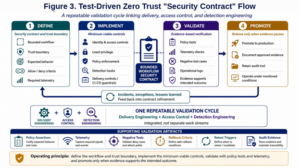
Figure 3 – Test-Driven Zero Trust “Security Contract” Flow (Define → Implement → Validate → Promote).
The engineering value of this strategy is that it makes architecture auditable without reducing assurance to static diagrams. Diagrams can show intended trust boundaries, but tests and logs show whether those boundaries are functioning. A policy decision record can show why a request was allowed or denied, which identity and device signals were validated, whether risk was elevated, and whether telemetry reached the SOC. That evidence supports internal assurance, external audit, incident investigation, and continuous authorization. The result is a zero trust program that moves from assertion to proof.
Federal and DoD Operational Friction Points
Federal and defense environments introduce constraints that are often underplayed in generic zero trust guidance. Air-gapped and high-side networks may not support the same identity federation, cloud telemetry patterns, or rapid policy propagation assumed in enterprise reference architectures. Cross-domain solutions can preserve mission connectivity, but they also create choke points where data tagging, content inspection, latency, and trust translation become security and operational issues simultaneously. Operational technology (OT), industrial control systems (ICS), tactical IoT, and mission systems frequently depend on fragile protocols, vendor-controlled maintenance windows, or long refresh cycles that make aggressive enforcement impractical without careful staging.
Coalition and mission-partner environments add another layer of complexity because trust must often be negotiated across organizational, national, and classification boundaries. The Defense Industrial Base faces similar realities in supply-chain assurance: subcontractor posture can be uneven, software provenance may be incomplete, and third-party access paths are frequently broader than policy owners intend. In these settings, zero trust cannot rely on abstract maturity targets alone. It must account for disconnected operations, varying assurance levels, inherited controls, and the practical friction between Authority to Operate processes, continuous authorization goals, and the tempo of mission delivery. Programs that acknowledge these constraints early are better positioned to define compensating controls, evidence requirements, and phased adoption paths that hold up under mission pressure.
Common Pitfalls and Lessons from the Field
Several failure modes recur across zero trust programs. First, telemetry volume is often mistaken for visibility; organizations ingest more data but do not improve detection quality, investigation speed, or decision authority. Second, exception creep quietly reintroduces implicit trust when emergency bypasses, broad allow lists, or inherited groups remain in place without expiration and retesting. Third, developer and platform teams experience policy gates as arbitrary friction when requirements are not risk-tiered and automation is not tuned to reduce false positives. Fourth, regression risk is commonly underestimated: identity claim changes, routing updates, legacy broker adjustments, and pipeline modifications can silently invalidate earlier security assumptions. Finally, many programs still pursue continuous authorization with governance processes that depend on episodic evidence collection and manual sign-off. Mature programs address these issues candidly by measuring signal quality, tracking exception age, validating rollback paths, and treating user friction as an operational metric rather than an anecdote.
IDENTITY AND ACCESS MODERNIZATION
Identity modernization is the center of gravity for zero trust because identity is the primary substrate for policy decisions. If an organization cannot uniquely identify users, administrators, service accounts, workloads, devices, and automated pipelines, it cannot reliably make contextual access decisions. A modern identity architecture should consolidate authoritative sources, reduce orphaned accounts, automate lifecycle management, normalize federation, enforce strong authentication, and map entitlements to business roles and resource sensitivity. This is especially important in hybrid enterprises where applications may still rely on SAML, OpenID Connect, LDAP, local accounts, and cloud-native identities simultaneously.
Password-centric access should be deliberately reduced. Current digital identity guidance has moved away from outdated composition rules and toward stronger authentication, risk-based controls, and phishing-resistant methods. NIST’s guidance on syncable authenticators recognizes that modern approaches can improve usability and recovery while supporting stronger authentication outcomes when designed properly. WebAuthn and FIDO-based passkeys provide public-key credential models that are resistant to traditional phishing because the credential is scoped to the relying party rather than being a shared secret that can be replayed across sites (NIST, 2024; World Wide Web Consortium [W3C], 2026).
The highest priority for phishing-resistant authentication should be privileged users, administrators, developers with production access, break-glass accounts, sensitive customer workflows, and roles with access to regulated or mission-critical data. This priority is consistent with zero trust because weak authentication undermines every downstream access decision. A user may appear authorized by group membership, but if the authentication method is vulnerable to phishing or token theft, the policy decision is far less trustworthy. Strong authentication therefore needs to be paired with device posture, session risk, user behavior, and continuous evaluation rather than treated as a one-time login event.
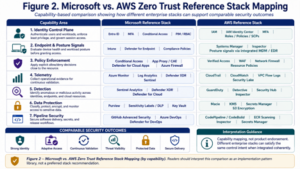
Across major enterprise stacks, the implementation pattern is similar: workforce access is governed through federated sign-on, strong and phishing-resistant authentication, device or posture-aware policy, and just-in-time privileged access; workload identity relies on short-lived credentials rather than embedded secrets; and authoritative control-plane and configuration telemetry supports audit, detection, and rapid revocation. The specific product choices matter less than whether the organization can apply these controls consistently across approved environments and tie them to protected workflows.
A practical way to simplify modernization is to define a small set of reusable identity patterns—workforce access, privileged access, workload identity, and third-party access—and apply them consistently where appropriate. This keeps policy design understandable, reduces exception sprawl, and makes identity evidence easier to audit and retest as applications migrate.
Lifecycle management is equally important: excessive standing privilege and stale access are common failure modes. Zero trust programs should modernize joiner–mover–leaver processes so that access is granted based on current role, reviewed regularly, removed promptly when no longer needed, and bounded by time, task, and approval context where appropriate. Privileged access should move toward just-in-time elevation with explicit approval, auditability, and rapid revocation when HR, risk, or device signals change. These practices reduce the blast radius of compromised accounts and make access decisions more explainable (Chandramouli et al., 2023).
Workload identity must mature alongside workforce identity in microservices, cloud platforms, Kubernetes clusters, API ecosystems, and CI/CD environments. Machines and services often generate more access requests than human users. If those workloads rely on long-lived secrets, shared credentials, broad service accounts, or inherited network trust, the enterprise remains vulnerable to lateral movement and credential replay. A zero-trust implementation should assign cryptographically verifiable identities to workloads, rotate credentials automatically, limit service-to-service communication to approved dependencies, and monitor for unexpected workload behavior. NIST SP 800-207A is particularly relevant because it focuses on access control for cloud-native applications in multi-location environments where network location is no longer an adequate trust basis.
The most practical migration approach is phased coexistence with controlled abstraction. Few organizations succeed by forcing workforce IAM, customer identity, legacy federation, and workload identity into a single immediate cutover. A more durable approach establishes target identity standards and then migrates application domains in sequence. High-risk applications should be prioritized for stronger authentication, normalized claims, and tighter privileged access, while lower-risk legacy systems can be placed behind brokers or gateways that enforce modern policy at the edge. This reduces risk quickly without requiring every application to be rewritten at once.
SOC MODERNIZATION AND THREAT DETECTION
SOC modernization is the verification-and-response loop for zero trust. Mature architectures generate far more contextual telemetry than perimeter-centric environments, including identity events, authentication strength, device posture, workload communication, cloud control-plane activity, application logs, data access, and deployment events. If those signals are not collected, normalized, enriched, and operationalized through detection engineering, organizations lose much of the measurable security value of zero trust. NIST incident response guidance and CSF 2.0 both reinforce that detection and response should function as part of continuous governance and improvement, not as an isolated alert queue (NIST, 2024, 2025).
A modern SOC should be organized around detection engineering rather than alert accumulation. The objective is not maximum alert volume, but high-confidence detections mapped to plausible adversary behavior and actionable response workflows. MITRE ATT&CK provides a common operational language by allowing teams to align detections, hunts, playbooks, red-team findings, and control gaps with specific tactics and techniques. This prevents the common failure mode in which organizations can demonstrate tool coverage but cannot explain whether they can detect credential dumping, token abuse, lateral movement, privilege escalation, command and control, or data exfiltration within the enterprise environment (MITRE, n.d.).
Coverage telemetry is foundational to zero trust operations. Identity logs without endpoint context can misclassify legitimate travel, device changes, or automated access. Endpoint alerts without identity context may fail to reveal privilege level, business criticality, or authorization scope. Cloud logs without application ownership may identify suspicious API activity without clear response authority. DevSecOps events without artifact provenance may show a deployment without validating whether the build itself was trustworthy.
A modern zero trust SOC should therefore enrich detections with identity, device, workload, application, data sensitivity, and change-management context. This improves prioritization, accelerates investigation, and supports more precise containment decisions.
Security information and event management (SIEM), extended detection and response (XDR), and security orchestration, automation, and response (SOAR) capabilities should be treated as complementary operational patterns rather than competing architectures. SIEM platforms remain important for broad telemetry ingestion, correlation, search, and compliance evidence across heterogeneous environments. XDR platforms can provide faster native correlation and control actions within integrated ecosystems. SOAR capabilities support playbooks, approvals, case management, enrichment, and response coordination.
The strategic objective is not selecting a dominant acronym, but establishing an architecture that delivers usable telemetry, reliable detections, safe automation, and effective response authority. Product consolidation may improve operations by increasing signal quality and reducing workflow friction, rather than simply centralizing alert volume.
In practice, mature SOC patterns combine broad telemetry ingestion, correlation, and search with integrated detections, governed automation, and tested playbooks. Whether implemented through more consolidated or more heterogeneous tooling, the objective is the same: produce high-confidence detections tied to identity, endpoint, cloud, application, and change context; retain evidence that supports investigations and audits; and use automation to reduce analyst drag without surrendering high-consequence decisions to opaque workflows.
Operational models for the SOC should define how detections are engineered, validated, escalated, and tied to remediation ownership. What distinguishes mature practice is not a proprietary framework name, but whether the organization can show repeatable triage, containment, recovery, and evidence retention across vulnerabilities, incidents, and policy violations.
A practical way to structure SOC modernization is to center it on detection engineering, tested playbooks, and evidence retention rather than on tool proliferation. The objective is to show that telemetry supports high-confidence detections, that response actions are governed and repeatable, and that operational evidence can support both incident handling and continuous assessment.
Response playbooks should define severity classifications, operational ownership, evidence requirements, approval boundaries, communication paths, containment procedures, rollback conditions, and post-incident learning activities. These practices help transform security operations from reactive alert handling into measurable operational verification processes capable of supporting continuous monitoring, audit readiness, and sustained Zero Trust maturity.
The most meaningful SOC metrics are operational and quality-oriented rather than volume-driven. Mean time to detect and contain should decline as telemetry, automation, and playbooks mature. False positives should drop as detections become more contextual. ATT&CK coverage should increase only when detections are validated and actionable. Automation may expand for repetitive workflows, but not at the expense of unsafe containment or reduced governance visibility. Reopened incidents and recurring findings should fall as remediation quality improves.
These measures provide stronger evidence of cybersecurity modernization maturity than raw alert counts, isolated tooling deployments, or dashboard-centric reporting because they demonstrate whether the organization can consistently detect, govern, respond to, and reduce operational risk over time.
SECURE DEVSECOPS PIPELINE
Secure DevSecOps pipelines are the delivery mechanism for zero trust because they determine whether software, infrastructure, policy, and observability artifacts enter the environment in a trustworthy manner. Runtime access controls are necessary, but they are not sufficient if the software supply chain is weak. An attacker who compromises source code, build scripts, dependencies, container images, infrastructure templates, secrets, or deployment credentials can bypass many downstream controls. NIST’s Secure Software Development Framework provides a baseline for secure development practices, while NIST SP 800-204D emphasizes integrating software supply chain security directly into DevSecOps CI/CD pipelines (Chandramouli et al., 2024; Souppaya et al., 2022).
The secure pipeline should be understood as a closed loop. Threat modeling identifies abuse cases and trust boundaries; developers and platform engineers translate those risks into security requirements; source code, infrastructure as code, policy definitions, and pipeline configurations are reviewed and tested; static analysis, secrets detection, dependency assessment, dynamic testing, infrastructure validation, container scanning, and policy gates provide layered assurance; build artifacts are signed and provenance is recorded; deployments are promoted through controlled environments; and runtime telemetry feeds lessons back into the backlog. This model prevents “shift-left” security from becoming a one-time scan and instead creates continuous feedback across the lifecycle.
Across common delivery platforms, the practical pattern is consistent: integrate code review, secrets detection, dependency assessment, infrastructure validation, artifact signing, and controlled promotion into the same delivery process used by engineering teams; route critical findings into incident and case-management workflows; and preserve provenance so teams can verify what was built, approved, and deployed during both routine change and incident response.
A practical way to reduce complexity is to standardize a small number of pipeline assurance patterns—for example, baseline controls for all services and elevated controls for internet-facing, mission-critical, or regulated workloads. This reduces developer friction while preserving strong provenance, testing, and promotion evidence where failure would be most damaging.
Infrastructure as code (IaC) deserves special emphasis because modern enterprise exposure often comes from configuration rather than application logic alone. A cloud route, storage policy, identity binding, firewall rule, Kubernetes admission policy, or secret reference can change the effective security posture of a system as much as source code. Treating infrastructure as code supports the view that IaC must be treated with software engineering discipline because it increasingly expresses complex system behavior (Sokolowski & Salvaneschi, 2023).
Policy as code is the connection point between zero trust architecture and DevSecOps execution. Organizations can define expectations such as deny-by-default access, required authentication strength, approved workload communication, mandatory telemetry, vulnerability thresholds, prohibited public exposure, and deployment approval conditions. Those expectations can then be evaluated during development, build, deployment, and runtime. The paper does not need to enumerate policy syntax; what matters is that policies are version-controlled, peer-reviewed, tested, traceable to requirements, and applied consistently across environments.
Software supply chain integrity should include dependency governance and artifact provenance. Third-party and transitive dependencies expand the trust boundary beyond the organization’s own code. Dependency scanning should identify known vulnerabilities, unmaintained packages, license concerns, and unacceptable risk thresholds. Artifact signing and provenance help ensure the software promoted to production is the same software that passed required checks. These practices support Supply-chain Levels for Software Artifacts (SLSA)-style supply chain maturity and provide stronger evidence for audit, incident response, and continuous authorization (OpenSSF, n.d.; Souppaya et al., 2022).
Pipeline controls should be risk-tiered rather than indiscriminate. A low-risk internal utility does not necessarily require the same gates as an internet-facing application that processes regulated data or a deployment pipeline that can modify production infrastructure. The most sensitive services should require stronger checks, explicit approvals, signed artifacts, deployment canaries, rollback conditions, and runtime validation. Lower-risk services can use lighter defaults while still maintaining baseline code review, vulnerability scanning, and secrets detection. This risk-tiered design reduces developer friction while preserving strong controls where failure would be most damaging.
DevSecOps also supports SOC modernization by producing telemetry that explains change. Many incidents are difficult to interpret because analysts cannot quickly determine what changed, who approved the change, which artifact was deployed, what dependency was introduced, or whether the event is consistent with an expected release. Integrating deployment metadata, artifact provenance, code ownership, and pipeline status into the SOC improves triage and reduces uncertainty. This is one reason zero trust, SOC modernization, and secure DevSecOps should be designed as one operating model rather than as parallel programs.
ROAD MAP METRICS AND GOVERNANCE
A practical zero trust road map should move through three overlapping phases. The first establishes visibility and foundational controls: identify crown-jewel workflows, map actors and resources, clean up identity sources, inventory privileged access, establish phishing-resistant authentication for administrators and production engineers, normalize telemetry for critical systems, and select a pilot workflow. The output should be a working access policy model, baseline telemetry, initial detection content, and a repeatable implementation pattern.
The second phase expands enforcement and engineering discipline. The organization extends policy enforcement to additional applications, adds workload identity to service-to-service paths, reduces standing privilege, builds ATT&CK-mapped detections, tests playbooks, and embeds security gates into CI/CD workflows. This is also the phase where exception management becomes critical. Exceptions should be time-bound, risk-accepted, visible to governance, and retested when conditions change; otherwise, the enterprise may appear to mature while the real trust boundary remains full of undocumented bypasses.
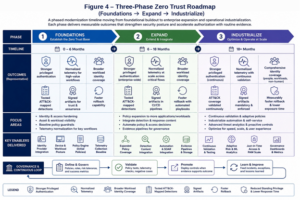
Figure 4 – Three-Phase Zero Trust Roadmap (Foundations → Expand → Industrialize).
| Phase | What changes | Success indicators |
| Foundations | Harden privileged identity, inventory critical assets, baseline telemetry, and pilot one high-value workflow. | % privileged users on phishing-resistant authentication; % critical assets inventoried; % high-value workflows with explicit policy; telemetry completeness; median revocation time. |
| Expand | Broaden enforcement, add workload identity, tune detections, and formalize exception governance. | % service paths using workload identity; % tested ATT&CK-mapped detections; exception age/compliance; % policy changes covered by tests; false-positive rate. |
| Industrialize | Automate evidence collection, normalize signed artifacts, and make continuous validation routine. | % signed artifacts; MTTD/MTTC; rollback time; % recurring findings reduced; % evidence generated automatically. |
Zero Trust Evidence Scorecard
Use this as a lightweight self-assessment. For each row, assign a score of 0 if the capability is absent or unsupported by evidence, 1 if it is partially implemented or inconsistently evidenced, and 2 if it is implemented, operationalized, and routinely supported by repeatable evidence.
| Pillar | Key evidence | Score (0 = absent, 1 = partial, 2 = evidenced) |
| Identity | Phishing-resistant admin auth; JIT elevation; access reviews; lifecycle automation. | |
| Devices & workloads | Asset inventory; posture-based policy; short-lived workload credentials; denied unauthorized paths. | |
| Networks | Explicit trust boundaries; tested segmentation; governed partner/cross-domain paths. | |
| Apps & data | Resource-side enforcement; scoped API access; transaction telemetry; documented exceptions. | |
| SOC | ATT&CK-mapped detections; telemetry validation; tested playbooks; retained evidence. | |
| DevSecOps | Signed artifacts; SBOM where needed; policy gates; tested rollback. | |
| Governance | Time-bound exceptions; KPI cadence; lessons learned fed back into policy and delivery. |
Effective governance is cross-functional. A practical steering model includes security architecture, identity, platform engineering, SOC leadership, application owners, privacy, and risk representatives. Its purpose is to establish common patterns, approve time-bound exceptions, prioritize high-value workflows, and keep modernization aligned to measurable outcomes such as reduced implicit trust, stronger authentication, faster revocation, better telemetry, higher detection precision, and safer deployments.
The best metrics are outcome-based. Identity metrics should track privileged users on phishing-resistant authentication, orphaned-account reduction, access revocation time, standing-privilege reduction, and entitlement-review completion. Architecture metrics should track high-value workflows protected by explicit policy, decision latency, percentage of segmentation changes covered by tests, and exception age. SOC metrics should track mean time to detect, mean time to contain, tested ATT&CK coverage, false-positive rate, reopened incidents, and playbook execution quality. DevSecOps metrics should track critical vulnerabilities blocked before production, secrets prevented from reaching repositories, signed-artifact coverage, dependency risk, change-failure rate, and rollback time.
The primary risks are organizational as much as technical. Identity cleanup may challenge local autonomy; application owners may resist stronger policy because legacy workflows depend on broad access; SOC teams may struggle with telemetry volume before detection quality improves; and developers may view security gates as friction if controls are not tuned and clearly justified. Procurement or licensing decisions can also encourage tool-driven adoption before the architecture is ready. These risks are best mitigated through phased pilots, transparent exception handling, reusable platform patterns, clear ownership, and continuous measurement of both security outcomes and user experience.
CONCLUSION
Zero trust succeeds when it is implemented as an evidence-producing engineering system. The architecture becomes real only when access to decisions, identity claims, workload communication, telemetry, detections, and software releases can be tested and verified. Identity modernization provides the policy substrate, SOC modernization provides the verification and response loop, and secure DevSecOps provides the delivery mechanism. When designed as one operating model, these capabilities reduce credential risk, limit lateral movement, improve detection quality, strengthen supply chain assurance, and support continuous control evidence.
The most defensible next step is to select one high-value workflow and implement the full pattern in a bounded way: define the trust model, modernize identity controls, express access expectations as testable policy outcomes, collect decision logs and telemetry, map detections to plausible adversary behavior, secure the deployment path, and measure both security and operational results. Done correctly, zero trust is not a slogan, a product, or a compliance overlay; it is a disciplined architecture for resilient digital operations.
For Further Reading
- NIST SP 800-207 for foundational zero trust principles and reference architecture concepts.
- NIST SP 1800-35 for implementation patterns, lessons learned, and mappings to common controls and frameworks.
- CISA Zero Trust Maturity Model 2.0 for phased maturity guidance across the five pillars and cross-cutting capabilities.
- NIST SP 800-218 and NIST SP 800-204D for secure software development and software supply chain practices within CI/CD.
- NIST SP 800-61 Rev. 3 for integrating incident response into broader cybersecurity risk management under CSF 2.0.
- CISA’s operational technology guidance for applying zero trust principles in ICS, OT, and safety-sensitive environments.
Glossary of Key Terms
- Crown-jewel workflow: Mission-critical process whose compromise would cause disproportionate harm.
- Evidence-centered security: Using policy decisions, tests, telemetry, and change records to prove controls work.
- Implicit trust: Access granted by default due to location, status, or prior authentication without continuous validation.
- Phishing-resistant authentication: Methods designed to resist credential theft and replay, such as FIDO-based passkeys.
- Policy-to-evidence loop: The cycle of enforcing policy, testing it, observing telemetry, measuring outcomes, and refining controls.
- Standing privilege: Persistent elevated access available even when not needed for the current task.
- Workload identity: A cryptographically verifiable identity for an application, service, container, or automated job.
- Zero trust: A cybersecurity approach that removes implicit trust and requires continuous verification based on identity, context, and risk.
APPENDIX A: REFERENCES
American Institute of Certified Public Accountants. (2023). SOC 2: SOC for service organizations.
Center for Internet Security. (2025). CIS Controls v8.1.
Chandramouli, R., Kautz, F., & Torres-Arias, S. (2024). Strategies for the integration of software supply chain security in DevSecOps CI/CD pipelines (NIST SP 800-204D). National Institute of Standards and Technology. https://doi.org/10.6028/NIST.SP.800-204D
Chandramouli, R., & Butcher, Z. (2023). A zero trust architecture model for access control in cloud-native applications in multi-location environments (NIST SP 800-207A). National Institute of Standards and Technology. https://doi.org/10.6028/NIST.SP.800-207A
Chhetri, M. B., Tariq, S., Singh, R., Jalalvand, F., Paris, C., & Nepal, S. (2024). Towards human–AI teaming to mitigate alert fatigue in security operations centres. ACM Transactions on Internet Technology, 24(3), Article 12, 1–22. https://doi.org/10.1145/3670009
Cybersecurity and Infrastructure Security Agency. (2022). Implementing phishing-resistant MFA.
Cybersecurity and Infrastructure Security Agency. (2023). Zero trust maturity model (Version 2.0).
Cybersecurity and Infrastructure Security Agency. (2023). Federal government cybersecurity incident and vulnerability response playbooks.
Feio, C., Santos, N., Escravana, N., & Pacheco, B. (2024). An empirical study of DevSecOps focused on continuous security testing. IEEE European Symposium on Security and Privacy Workshops.
Hunt, P., Grizzle, K., Ansari, M., Wahlstroem, E., & Mortimore, C. (2015). System for cross-domain identity management: Protocol (RFC 7644). Internet Engineering Task Force.
Joint Task Force. (2012). Guide for conducting risk assessments (NIST SP 800-30 Rev. 1). National Institute of Standards and Technology.
Joint Task Force. (2020). Security and privacy controls for information systems and organizations (NIST SP 800-53 Rev. 5). National Institute of Standards and Technology.
Microsoft. (2022). Threat Modeling Tool: Overview.
MITRE. (n.d.). ATT&CK enterprise matrix.
Pascoe, C., Quinn, S., & Scarfone, K. (2024). The NIST Cybersecurity Framework (CSF) 2.0 (NIST CSWP 29). National Institute of Standards and Technology. https://doi.org/10.6028/NIST.CSWP.29
National Institute of Standards and Technology. (2024). Incorporating syncable authenticators into NIST SP 800-63B (NIST SP 800-63Bsup1). https://doi.org/10.6028/NIST.SP.800-63Bsup1
Nelson, A., Rekhi, S., Souppaya, M., & Scarfone, K. (2025). Incident response recommendations and considerations for cybersecurity risk management: A CSF 2.0 community profile (NIST SP 800-61 Rev. 3). National Institute of Standards and Technology. https://doi.org/10.6028/NIST.SP.800-61r3
OpenSSF. (n.d.). Supply-chain Levels for Software Artifacts (SLSA).
PCI Security Standards Council. (2024). Payment Card Industry Data Security Standard (PCI DSS) (Version 4.0.1).
Rose, S., Borchert, O., Mitchell, S., & Connelly, S. (2020). Zero trust architecture (NIST SP 800-207). National Institute of Standards and Technology. https://doi.org/10.6028/NIST.SP.800-207
Rose, S., Borchert, O., Howell, G., Kerman, A., Souppaya, M., et al. (2025). Implementing a zero trust architecture: High-level document (NIST SP 1800-35). National Institute of Standards and Technology. https://doi.org/10.6028/NIST.SP.1800-35
Sakimura, N., Bradley, J., Jones, M., de Medeiros, B., & Mortimore, C. (2023). OpenID Connect Core 1.0. OpenID Foundation.
Souppaya, M., Scarfone, K., & Dodson, D. (2022). Secure software development framework (SSDF) version 1.1 (NIST SP 800-218). National Institute of Standards and Technology. https://doi.org/10.6028/NIST.SP.800-218
Tariq, S., Chhetri, M. B., Nepal, S., & Paris, C. (2025). Alert fatigue in security operations centres: Research challenges and opportunities. ACM Computing Surveys, 57(9), Article 224, 1–38. https://doi.org/10.1145/3723158
World Wide Web Consortium. (2026). Web Authentication: An API for accessing public key credentials (WebAuthn) Level 3 (Candidate Recommendation Snapshot, January 13, 2026).